Gen AI in Education
While AI is a very powerful tool to use when making the scaffolding of an assignment or research, it comes with many limitations which many people don’t fully grasp. With students becoming more and more reliable on AI with every new GPT update, I think its important to cover its fallbacks so that people understand where it can be most effectively implemented. AI operates on probability/predictability, not truth. It can confidently invent chemical reactions, cite non-existent research papers, or provide incorrect physics formulas that look like the real thing. On top of that, like humans AI has its own biases based off the information its fed. This can lead to cultural insensitive responses or AI providing the most common or conventional answer rather than encouraging inquiry. Lastly depending on the depth of the prompt and follow up questions what it provides is less practical for use than something a human would create.
Source: https://www.youtube.com/watch?v=GwEjuhpo26o
Now that we understand some of the limitations of AI lets cover what it can be used for in the science classroom. Science is a topic that requires some rote memorization be it body systems, or components of a cell, and AI can be a great tool to aid in the memorization of this material. AI can help brainstorm mnemonics, or flash cards so that you can compartmentalize the information better. AI can also be used to convert scientific material into layman’s terms as much of the content contains hard to understand terms and is formatted in a way so that only those with post-secondary experience can read. Lastly I think AI is a good way to find the initial resources for most inquiry or research based assignments. Asking for a set of 10 websites or papers that relate to your assignment is a good way to start and can provide access to research otherwise hidden in the crowds of google results.
An example Gemini AI prompt: “Create me an image of a scientist lighting a Bunsen burner”
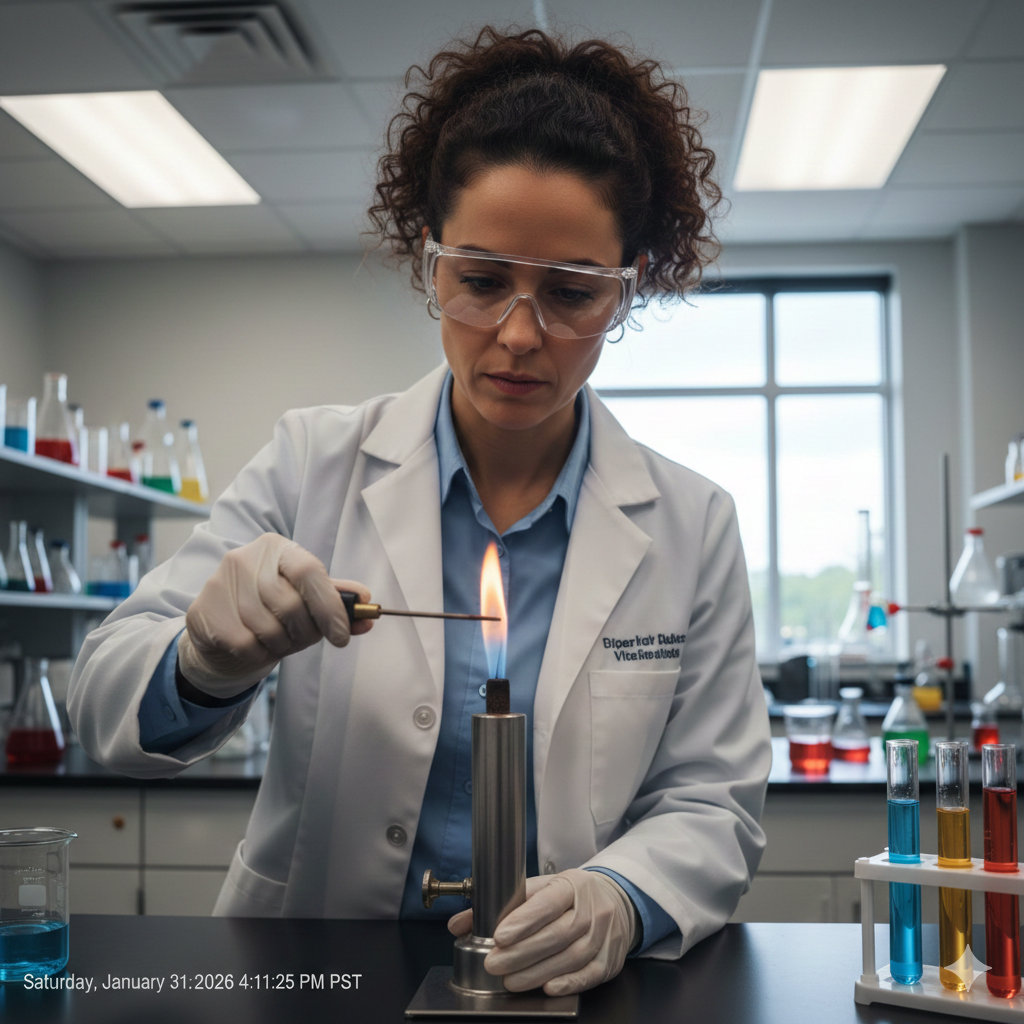
Source: Google Gemini AI 3